Module 2 - Session 4: Training and Evaluating Your Classifier
Session 4
Setting Up Training
Everything you need:
- Model (on device)
- Loss function
- Optimizer
- Data loaders
Device and Model Setup
Both model and data must be on the same device
Loss Function
Designed for classification tasks
Perfect for choosing a digit from 0-9
Optimizer
Adam: adapts learning rate as it trains
- Larger adjustments early (noisy gradients)
- Smaller corrections later (training stabilizes)
Training Function
def train_one_epoch(model, dataloader, loss_fn, optimizer, device):
    model.train()  # Set to training mode
    running_loss = 0.0
    correct = 0
    total = 0

    for batch_idx, (data, targets) in enumerate(dataloader):
        # Move to device
        data, targets = data.to(device), targets.to(device)

        # Training steps
        optimizer.zero_grad()
        outputs = model(data)
        loss = loss_fn(outputs, targets)
        loss.backward()
        optimizer.step()

        # Track progress
        running_loss += loss.item()
        _, predicted = outputs.max(1)
        total += targets.size(0)
        correct += predicted.eq(targets).sum().item()

        if batch_idx % 100 == 0:
            print(f'Loss: {loss.item():.4f}, '
f'Accuracy: {100.*correct/total:.2f}%')Understanding the Training Progress
With 60,000 training images and batch size 64:
- About 938 batches per epoch
- Around 9 progress updates
Watch the numbers:
- Loss: dropping (0.64 → 0.17)
- Accuracy: climbing (81% → 95%)
Evaluation Function
def evaluate(model, dataloader, device):
    model.eval()  # Set to evaluation mode
    correct = 0
    total = 0

    with torch.no_grad():  # Disable gradient tracking
        for data, targets in dataloader:
            data, targets = data.to(device), targets.to(device)
            outputs = model(data)
            _, predicted = outputs.max(1)
            total += targets.size(0)
            correct += predicted.eq(targets).sum().item()

return 100. * correct / totalPutting It All Together
10 epochs = 10 full passes through training data
After each epoch: evaluate on test set
What You’ll See
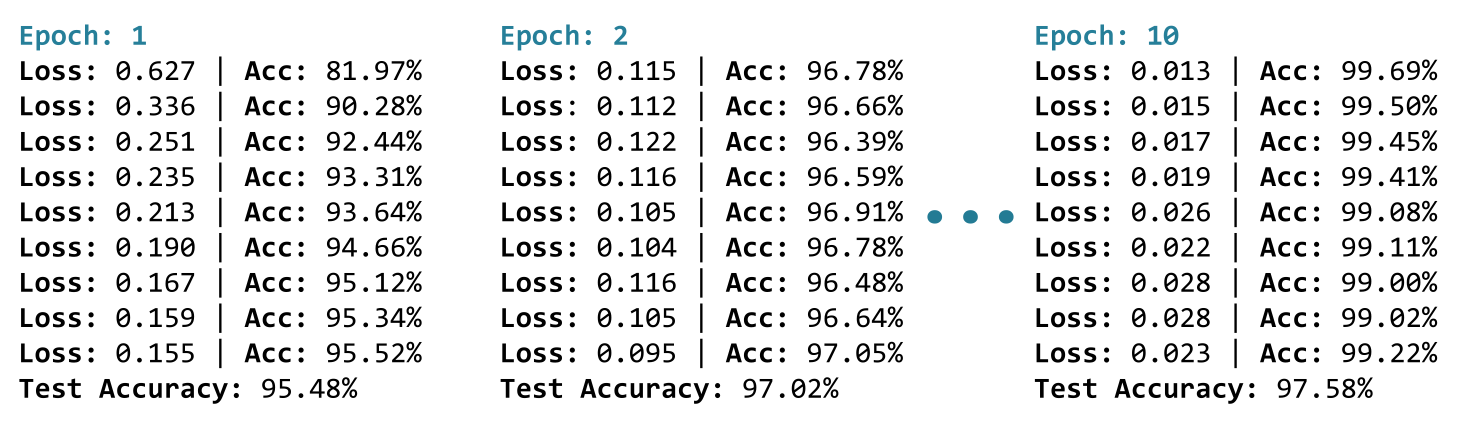
By epoch 10: Loss: tiny, Accuracy: high (often 95%+)
When accuracy stops improving: Model is done learning, May not need all 10 epochs
Module 2 Summary
You’ve learned:
- PyTorch data pipeline (Dataset, DataLoader, Transforms)
- Building custom models with
nn.Module - Loss functions (MSE vs Cross-Entropy)
- How optimizers use gradients to update weights
- Device management (CPU vs GPU)
- Complete image classification pipeline
Lab 1: Building Your First Image Classifier
“Don’t tell me the moon is shining; show me the glint of light on broken glass.”
CUE: START THE LAB HERE
Assignment 2: EMNIST Letter Detective
“The eye sees only what the mind is prepared to comprehend.”
CUE: START THE ASSIGNMENT HERE
What’s Next?
In Module 3: Data Management we learn:
- How to manage and preprocess data for deep learning
- How to build a robust data pipeline
- How to use data augmentation to improve model performance
- How to use data validation to ensure model performance
