Day 2: Embeddings

Module Overview

Session: Embeddings

Session: Embeddings

What You’ll Learn Today

By the end of this session, you will:

  • Understand embeddings as numerical representations of data
  • Know how to evaluate embedding quality
  • Recognize different types of embeddings and their use cases

What Are Embeddings?

Numerical representations of real-world data

Embeddings as vectors in a low-dimensional space representing text, images, and other data types

Why Embeddings Matter

Compact, meaningful representations

  • Lossy compression: Reduce dimensionality while preserving semantics
  • Similarity comparison: Measure relationships numerically
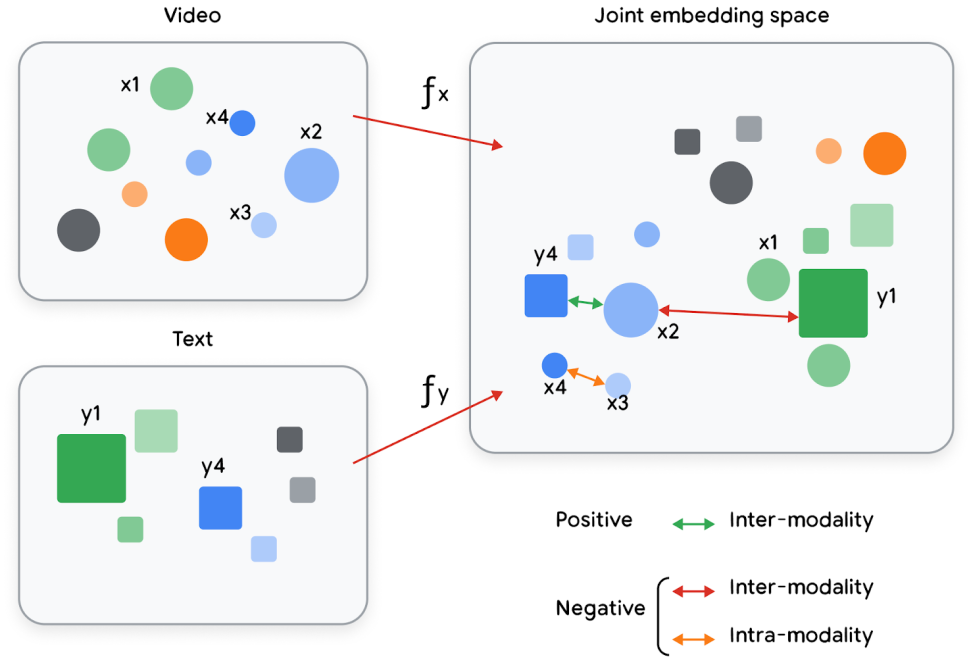
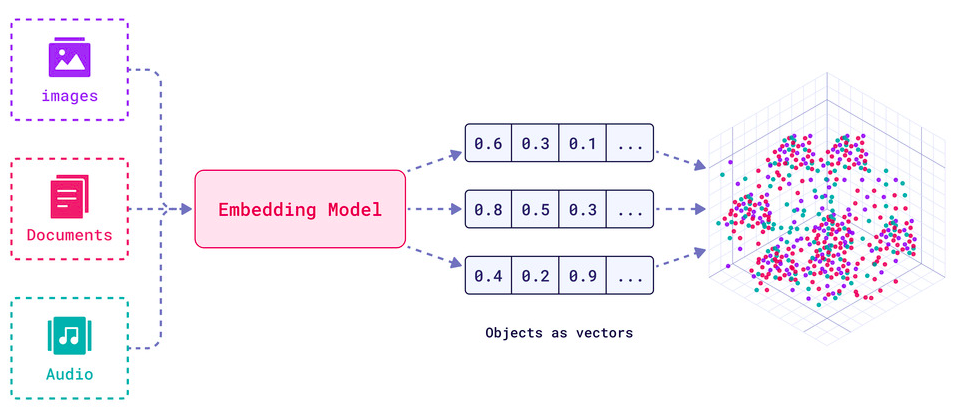
  • Multimodal alignment: Map different data types to the same space
  • Efficient computation: Enable fast search and retrieval

Embeddings in Retrieval Systems

The three-step process

  1. Precompute embeddings for billions of items
  2. Map query embeddings into the same space
  3. Retrieve nearest neighbors efficiently

Joint Embeddings for Multimodality

Multiple data types in one space

Objects of different types (text, images, videos) projected into a joint vector space with semantic meaning

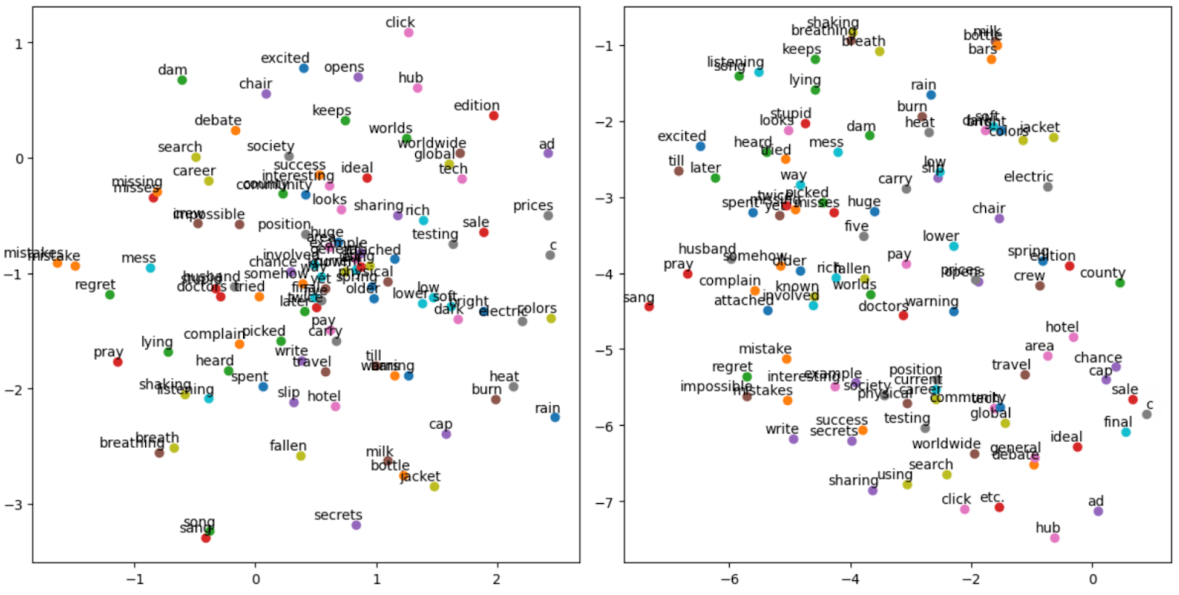
Task-Specific Embeddings

2D visualization of pre-trained GloVe and Word2Vec word embeddings

Different embeddings for different tasks

  • Same object → different embeddings
  • Optimized for the task at hand
  • Semantic meaning preserved for specific use cases

Evaluating Embedding Quality

Why Evaluation Matters

Bad embeddings → bad results

  • Embeddings are not automatically good
  • Quality depends on model, data, and task
  • Evaluation tells you if embeddings work for your use case

Evaluation Methods

  • Intrinsic evaluation: Direct measurement of embedding properties
  • Extrinsic evaluation: Performance on downstream tasks (IR, classification, ..etc.)
  • Benchmarks: MTEB, BEIR for standardized comparison

Search Example: The Challenge

Finding relevant documents

  • Query: “How do I reset my password?”
  • Corpus: Millions of support articles
  • Goal: Find the most relevant articles

Types of Embeddings

Text Embeddings Overview

From words to documents

  • Word embeddings: Individual words → vectors
  • Document embeddings: Entire documents → vectors
  • Context-aware: Meaning depends on surrounding text

Word Embeddings

Individual words as vectors

  • Word2Vec: Predicts words from context
  • GloVe: Global word-word co-occurrence statistics
  • FastText: Handles out-of-vocabulary words

Word embeddings showing similar words clustered together in vector space

Document Embeddings: Shallow Models

Bag-of-words approaches

  • TF-IDF: Term frequency × inverse document frequency
  • BM25: Probabilistic ranking function
  • Limitations: No word order, no context

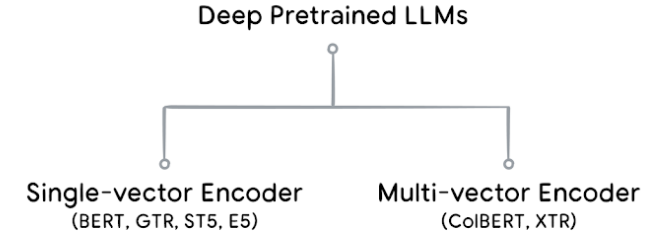
Document Embeddings: Deep Models

Context-aware neural embeddings

  • BERT: Bidirectional encoder representations
  • Sentence-BERT: Efficient sentence embeddings
  • Modern LLMs: GPT, T5, Gemini embeddings

Single-vector vs. Multi-vector encoders

Image & Multimodal Embeddings

Visual understanding in vector space

  • CNN-based: Convolutional neural networks for images
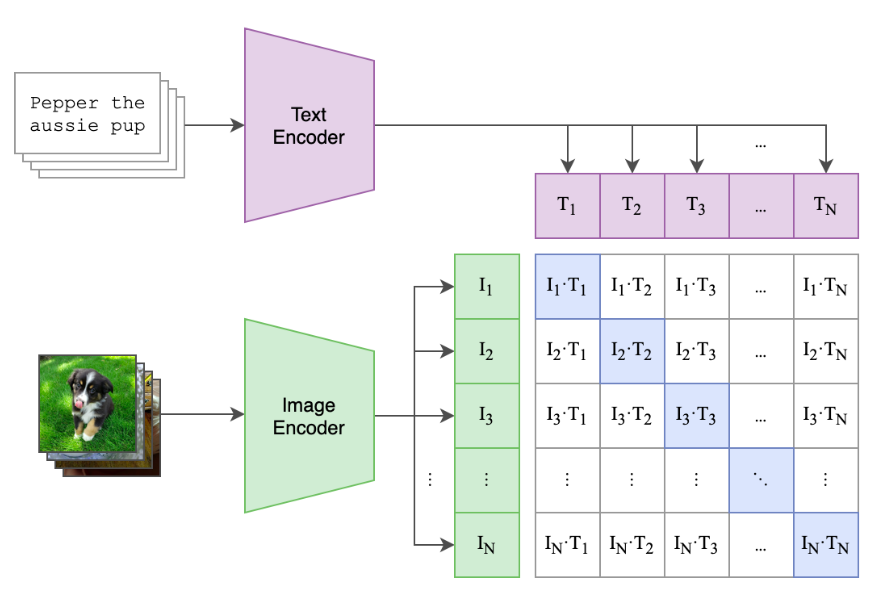
  • Vision transformers: ViT, CLIP for joint text-image space
  • Multimodal: Same space for text, images, videos

Images and text projected into a joint embedding matrix (OpenAI’s CLIP model)

Structured Data Embeddings

Tables, graphs, and relational data

  • General structured data: Feature engineering + ML
  • User-item data: Collaborative filtering embeddings
  • Graph embeddings: Node and edge representations
Training Embeddings

Training Approaches

How embeddings are learned

  • Supervised: Task-specific labels guide learning
  • Self-supervised: Learn from data structure itself
  • Transfer learning: Pre-trained models fine-tuned

Pre-trained vs. Custom Embeddings

When to train your own

  • Pre-trained: Use when available, often better
  • Custom: Needed for domain-specific tasks
  • Fine-tuning: Best of both worlds