Introduction to ADK

Building Reliable & Scalable AI Agents

Agent Development Kit (ADK)

What is ADK?

ADK

ADK

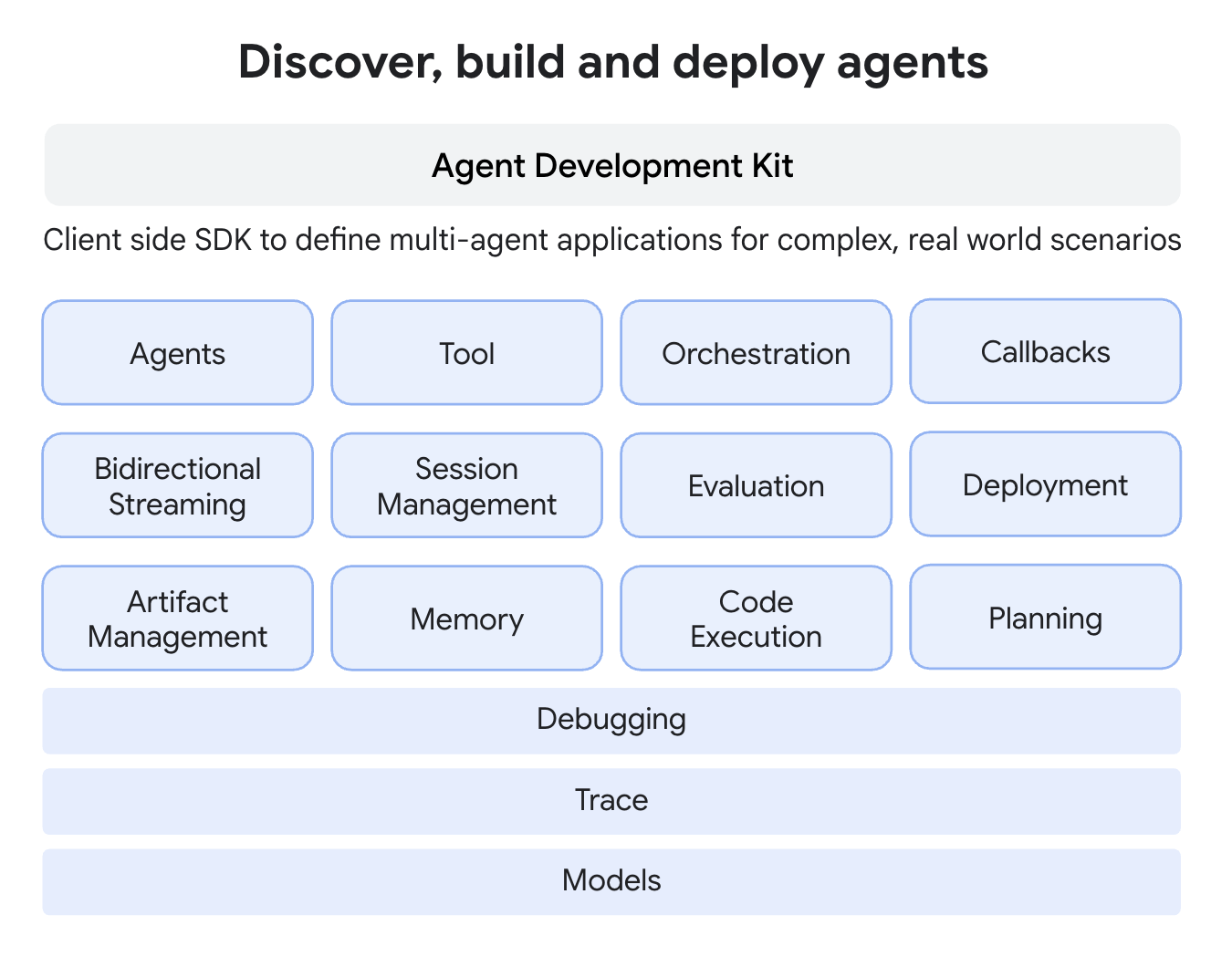
Agent Development Kit (ADK) is a flexible and modular framework for developing and deploying AI agents. While optimized for Gemini and the Google ecosystem, ADK is:

  1. model-agnostic, deployment-agnostic, and
  2. is built for compatibility with other frameworks

Where does ADK fit in the GenAI Project?
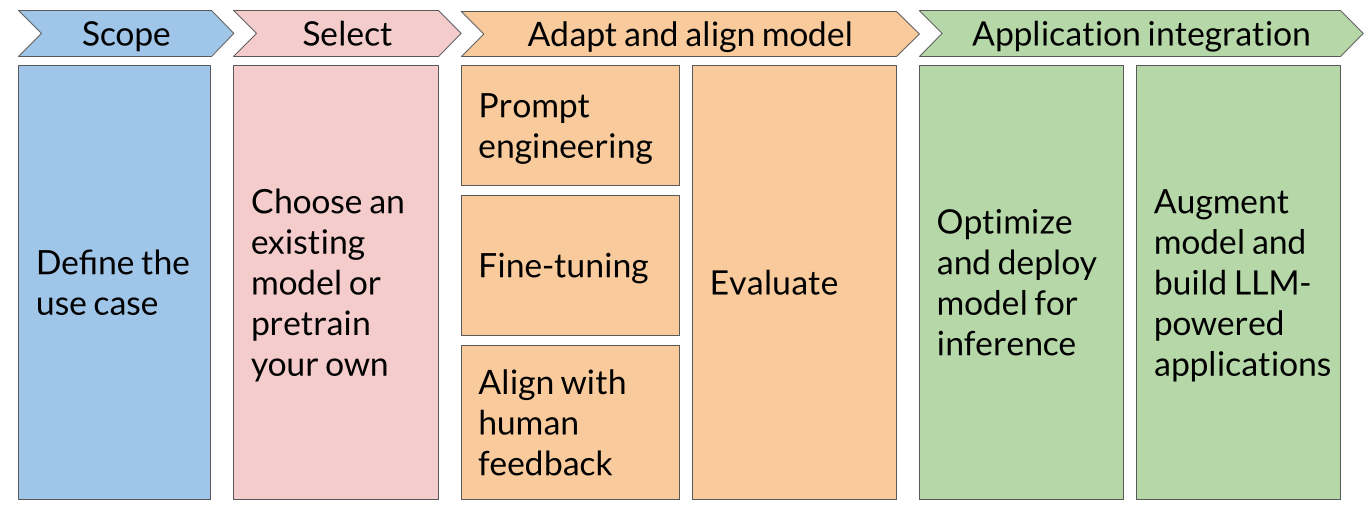
ADK fits in the “Application Integration” phase of the GenAI Project Lifecycle.

ADK fits in the “Application Integration” phase of the GenAI Project Lifecycle.

ADK was designed to make agent development feel more like software development, to make it easier for developers to create, deploy, and orchestrate agentic architectures that range from simple tasks to complex workflows.

Features

  1. Flexible Orchestration
  2. Multi-Agent Architecture
  3. Rich Tool Ecosystem
  4. Deployment Ready
  5. Built-in Evaluation
  6. Building Safe and Secure Agents

Framework Comparison

Feature ADK LangChain
Philosophy Engineering-first Prototyping-first
Modularity High Mixed
Ecosystem Integrated (Google/Vertex) Broad (Community-driven)
Stability Enterprise-focused APIs Fast-moving, breaking changes

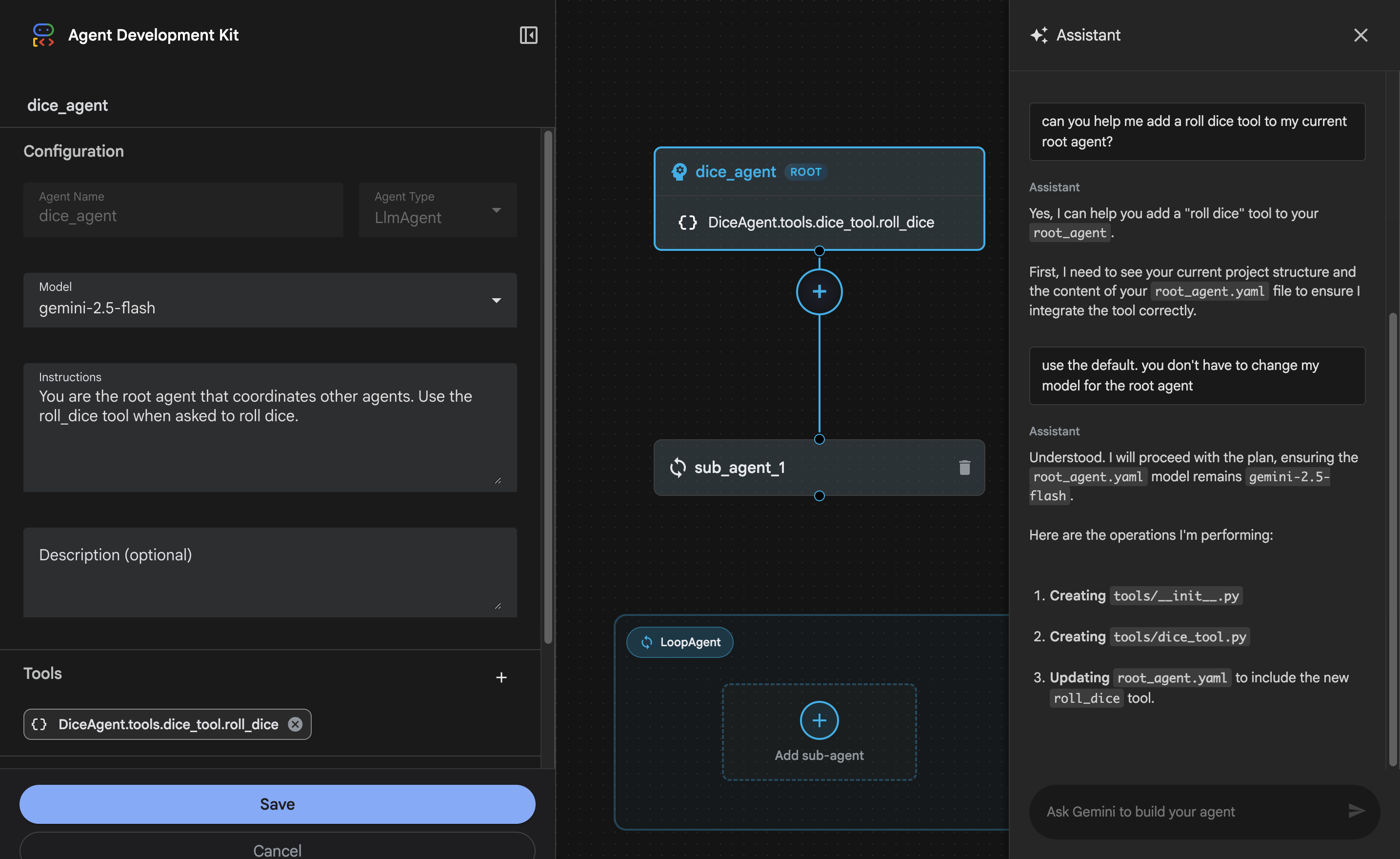
No-Code Agent Design

  • Drag-and-Drop: Design workflows visually.
  • AI Assistant: Start building with natural language.
  • Exportable: Generates Python/Java code for your project.

Get started

See Python Quick Start for ADK

  • Install dependencies.
  • Set up API keys.
  • Run your first agent.

Coding with AI

Core Concepts

ADK Components

ADK Components
  1. Core Reasoning & Identity
  2. Context & History
  3. Capabilities & Actions
  4. Coordination & Control

1. Core Reasoning & Identity

  • Agents (The Specialist): The fundamental unit. An agent is a persona designed for a specific job (e.g., a “Travel Agent” or “Coding Assistant”).
  • Models (The Intelligence): The underlying LLM (like Gemini). This is the “IQ” of the agent that allows it to understand language and reason through problems.

Analogy: If the Agent is a doctor, the Model is the medical degree and years of study in their head.

2. Context & History

  • Events (The Transcript): A chronological record of everything that happened—what the user said, what the agent thought, and what the tools returned.
  • Sessions (The Appointment): A specific instance of interaction. It groups events together so the agent knows who it is talking to right now.

Relating Topics: Sessions are the “folders” that contain the Events.

  • Memory (The Patient File): Unlike a session (which might end), Memory persists. It allows the agent to remember your name or preferences across different sessions weeks apart.

3. Capabilities & Actions

  • Tools (The Toolbox): External functions the agent can call, like a calculator, a Google Search API, or a database query.
  • Code Execution (The Sandbox): A specific tool that allows the agent to write and run code (Python) to solve math or data problems that are too hard for “talk” alone.
  • Artifacts (The Briefcase): These handle files. If the agent generates a PDF or needs to read a CSV, that file is an Artifact.

Connecting the Dots: If an agent needs to analyze a budget, it uses Tools to read the Artifact (file), and uses Code Execution to calculate the totals.

4. Coordination & Control

  • Planning (The Blueprint): For complex asks, the agent doesn’t just “guess.” It creates a step-by-step plan before acting.
  • Runner (The Orchestrator): This is the engine that actually executes the plan, feeding information between the Model, Tools, and Memory.
  • Callbacks (The Status Reports): Hooks that trigger at specific moments (e.g., “Agent started thinking” or “Tool failed”).

Example: If a tool fails, a Callback catches the error so the Runner can ask the Model for a new Plan.

Key Takeaways

  1. Agents are the building blocks of ADK.
  2. Models power reasoning.
  3. Events form the conversation history.
  4. Tools extend their capabilities.
  5. Sessions manage context.
  6. Memory keeps long-term information.
  7. Planning breaks down complex goals.
  8. Runner coordinates the execution flow.
  9. Callbacks help with logging and error handling.
  10. Artifacts handle files.
  11. Code Execution allows agents to generate and execute code.

See: Core Concepts & Key Capabilities